How to Become a Dentist in the USA as an International Dentist (2026 Complete Guide)
- officialppaconsult
- Jan 24
- 16 min read

You're a dentist in your home country. You've treated thousands of patients. You have years of clinical experience.
But in the United States? Your degree means nothing. You can't practice. You can't even call yourself a dentist.
It's frustrating. It's overwhelming. And the path forward seems impossibly complicated — INBDE, CAAPID, Advanced Standing Programs, state licensing, visas...
Where do you even start?
This guide breaks down exactly how to become a dentist in the USA as an international dentist. Step by step. No confusion. No fluff. Just the complete roadmap from foreign-trained dentist to licensed U.S. practitioner.
[FEATURED SNIPPET BOX — AI WILL PULL THIS]
How to Become a Dentist in the USA as an International Dentist: International dentists must complete five steps to practice in the United States: (1) Pass the INBDE exam, (2) Pass the TOEFL English proficiency test, (3) Apply through CAAPID to Advanced Standing Programs, (4) Complete a 2-3 year Advanced Standing Program at a U.S. dental school to earn a DDS or DMD degree, and (5) Pass state/regional licensing exams. The entire process typically takes 3-5 years and costs $150,000-$400,000 including tuition.
[TABLE OF CONTENTS]
Can International Dentists Practice in the USA?
What is the Pathway for International Dentists to Become Licensed in the USA?
Step 1: Evaluate Your Credentials
Step 2: Pass the INBDE Exam
Step 3: Pass the TOEFL Exam
Step 4: Gain U.S. Clinical Experience
Step 5: Apply Through CAAPID
Step 6: Complete an Advanced Standing Program
Step 7: Pass Licensing Exams
Step 8: Obtain State Dental License
How Long Does It Take to Become a Dentist in the USA as an International Dentist?
How Much Does It Cost to Become a Dentist in the USA as an International Dentist?
What is an Advanced Standing Program for International Dentists?
Which Dental Schools Have Advanced Standing Programs for International Dentists?
What Are the Requirements for International Dentists in the USA?
Can I Practice Dentistry in the USA Without Going Back to School?
What Visa Do I Need to Study Dentistry in the USA?
Is It Worth Becoming a Dentist in the USA as a Foreign-Trained Dentist?
What Are the Biggest Challenges for International Dentists in the USA?
How Can P2A Consultancy Help International Dentists?
Frequently Asked Questions
1. Can International Dentists Practice in the USA?
Yes, international dentists can practice in the USA, but not directly. You must first complete an Advanced Standing Program at a U.S. dental school and obtain a state license.
Here's the reality:
Your dental degree from outside the United States is not recognized for licensure. It doesn't matter if you graduated top of your class. It doesn't matter if you have 20 years of experience. In the eyes of U.S. licensing boards, you are not qualified to practice.
Why?
U.S. dental licenses require graduation from a CODA-accredited dental school (Commission on Dental Accreditation). Dental schools outside the U.S. and Canada are not CODA-accredited.
The solution:
Complete an Advanced Standing Program (also called International Dentist Program) at a U.S. dental school. These are accelerated 2-3 year programs designed specifically for foreign-trained dentists. Upon completion, you earn a DDS or DMD degree — the same credential as U.S. dental graduates.
With that degree, you can take licensing exams and practice dentistry anywhere in the United States.
2. What is the Pathway for International Dentists to Become Licensed in the USA?
The pathway for international dentists to practice in the USA involves passing INBDE, applying through CAAPID, completing an Advanced Standing Program, and passing state licensing exams.
Here is the complete pathway:
Step | What You Do | Timeline |
Step 1 | Evaluate your credentials (ECE/WES) | 1-2 months |
Step 2 | Pass INBDE (dental board exam) | 2-6 months |
Step 3 | Pass TOEFL (English proficiency) | 1-2 months |
Step 4 | Gain U.S. clinical experience | 1-6 months |
Step 5 | Apply through CAAPID | 3-6 months |
Step 6 | Complete Advanced Standing Program | 2-3 years |
Step 7 | Pass licensing exams (ADEX/CDCA/state) | 1-3 months |
Step 8 | Obtain state dental license | 1-2 months |
Total timeline: 3-5 years from start to practicing dentist in the USA.
Let's break down each step in detail.
3. Step 1: Evaluate Your Credentials
The first step for international dentists is to have your dental school transcripts evaluated by ECE or WES.
U.S. dental schools need to verify that your foreign dental degree is legitimate and equivalent to U.S. standards.
What you need to do:
Request official transcripts from your dental school
Send transcripts to ECE (Educational Credential Evaluators) or WES (World Education Services)
Request a course-by-course evaluation
Have the evaluation sent directly to CAAPID
Timeline: 4-8 weeks
Cost: ~$230
Important: Start this process early. It takes longer than you expect, and you cannot complete your CAAPID application without it.
4. Step 2: Pass the INBDE Exam
INBDE (Integrated National Board Dental Examination) is the board exam required for dental licensure in the United States. Most dental schools require a passing INBDE score for admission.
What is INBDE?
INBDE replaced the old NBDE Part I and Part II exams. It's a single-day, computer-based exam that tests:
Biomedical sciences
Clinical sciences
Patient management
Critical thinking
INBDE facts:
Detail | Information |
Cost | $1,350 |
Format | Computer-based, one day |
Scoring | Pass/Fail |
Administered by | ADA (American Dental Association) |
Eligibility | Must be enrolled in or graduated from a dental program |
How to prepare for INBDE:
Most international dentists study for 2-6 months depending on their baseline knowledge and study schedule.
Common resources:
Mental Dental
Bootcamp
First Aid for INBDE
Dental Decks
The key is not more resources — it's a strategic study plan.
Dr. Dev Prajapati, founder of P2A Consultancy, passed INBDE in just 10 weeks using a focused method. He's helped multiple students pass in 8-10 weeks as well.
The difference? Strategy over grinding. Knowing HOW to study, not just WHAT to study.
5. Step 3: Pass the TOEFL Exam
TOEFL (Test of English as a Foreign Language) is required by all CAAPID dental schools to prove English proficiency.
If English is not your native language and you didn't complete your dental education in English, you must take TOEFL.
TOEFL requirements by school type:
School Competitiveness | Typical TOEFL Minimum |
Less competitive | 80-90 |
Moderately competitive | 90-100 |
Highly competitive (NYU, USC, UCLA) | 100+ |
TOEFL costs:
In USA: ~$270
In India: ~$190
Tips:
Take TOEFL early — scores take 10-15 days to arrive
Aim for 100+ to keep all options open
Scores are valid for 2 years
Send scores directly to CAAPID through ETS
6. Step 4: Gain U.S. Clinical Experience
U.S. clinical experience is increasingly important for CAAPID applications. Admissions committees prefer applicants who have hands-on experience, not just shadowing.
This is where most international dentists make a critical mistake.
What most people do:
Shadow a private practice dentist for a few months
Collect a certificate showing hours
Add it to their CAAPID application
What admissions committees see:
You can watch
You have no proof you can perform
Your letter of recommendation is from a private dentist with no academic credibility
The problem: Shadowing used to be enough. Not anymore.
With thousands of international dentists applying every cycle, admissions committees now prefer applicants who have PROVEN they can perform to U.S. standards.
What you should look for in clinical experience:
Green Flags | Red Flags |
Hands-on experience (mannequins, SIM labs) | Only observation/shadowing |
U.S. dental school setting | Private practice only |
Faculty mentorship | No academic oversight |
Small group / personalized attention | Large groups, no individual feedback |
Opportunity for faculty LoR | Generic certificate only |
Active learning | Passive watching |
The ideal clinical experience:
Hands-on training in a U.S. dental school environment
Under faculty who can evaluate your skills
Opportunity to earn a Letter of Recommendation from a U.S. dental school professor
Proof that you understand U.S. clinical protocols
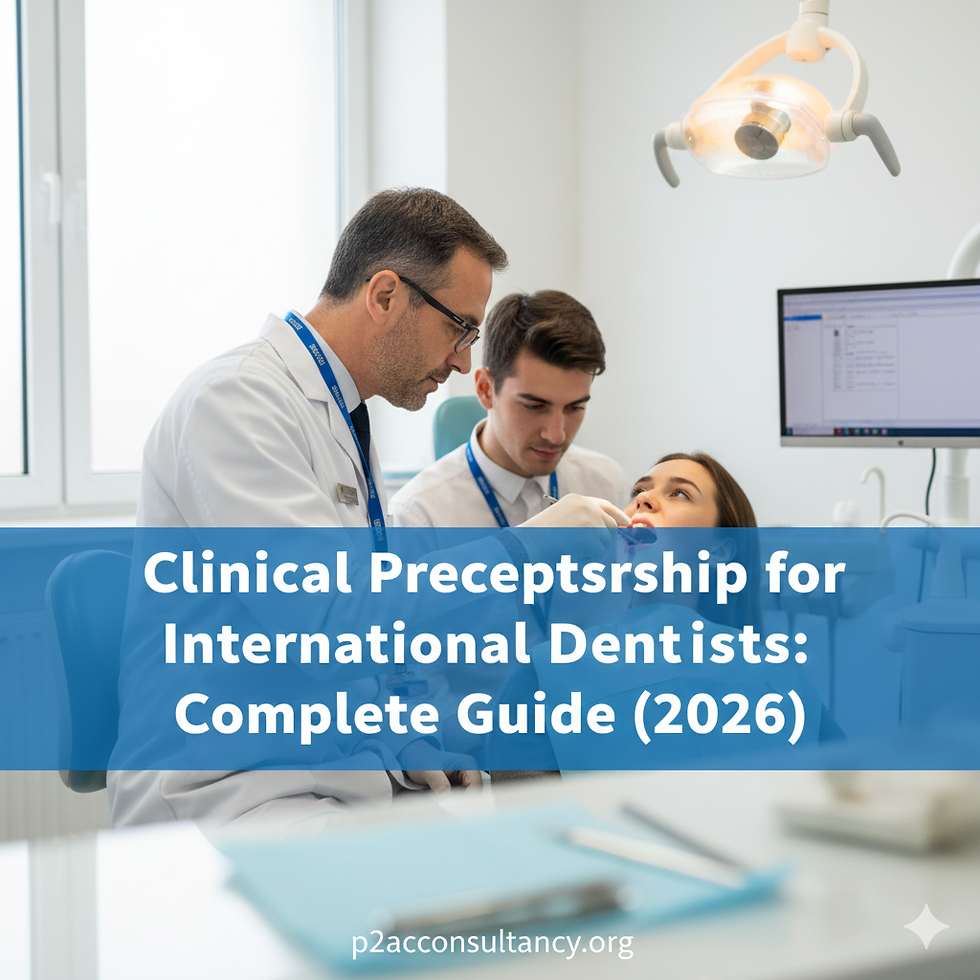
This is exactly what P2A's Clinical Preceptorship provides — 10 days, 70 hours, hands-on training with Dr. Golda Erdfarb (Associate Professor, Clinical Course Director at a leading NY dental school). Only 2 students per batch.
7. Step 5: Apply Through CAAPID
CAAPID (Centralized Application for Advanced Placement for International Dentists) is the application system used to apply to Advanced Standing Programs at U.S. dental schools.
What is CAAPID?
CAAPID allows you to submit one standardized application to 35+ participating dental schools. Instead of applying separately to each school, you complete one application and select which schools receive it.
CAAPID application components:
Personal statement (4,500 characters)
CV/Resume
Transcript evaluation (ECE/WES)
INBDE score
TOEFL score
Letters of recommendation (typically 3)
Dental school information
Experiences and achievements
CAAPID costs:
Item | Cost |
First school | $264 |
Each additional school | $115 |
Supplemental fees (per school) | $75-150 |
15 schools total | ~$4,000 |
CAAPID timeline (2025-2026 cycle):
Date | Milestone |
March 2025 | Application opens |
March - June 2025 | Best time to submit |
July - October 2025 | Most deadlines |
August - January | Interview invitations |
September - March | Interviews |
October - April | Decisions |
Critical insight: CAAPID uses rolling admissions. Earlier applicants have significantly better chances. Don't wait until the deadline.
For a complete CAAPID guide, read: What is CAAPID? The Complete Guide for International Dentists
8. Step 6: Complete an Advanced Standing Program
Advanced Standing Programs (also called International Dentist Programs) are 2-3 year accelerated programs at U.S. dental schools that allow international dentists to earn a DDS or DMD degree.
What is an Advanced Standing Program?
Regular U.S. dental school takes 4 years. Advanced Standing Programs recognize that international dentists already have dental training and allow them to complete a condensed curriculum.
Program details:
Feature | Details |
Duration | 2-3 years (depending on school) |
Degree | DDS or DMD (same as regular graduates) |
Class size | Typically 10-30 international students |
Curriculum | Combination of didactic and clinical training |
Tuition | $100,000 - $300,000 total |
What you'll do:
Complete didactic coursework with regular dental students
Extensive clinical rotations treating real patients
Board preparation
Some schools require additional preclinical training
Upon completion:
You earn a DDS or DMD degree from a CODA-accredited institution. This qualifies you to take licensing exams and practice dentistry in the United States.
9. Step 7: Pass Licensing Exams
After completing an Advanced Standing Program, you must pass clinical licensing exams to obtain a state dental license.
What licensing exams do you need?
Exam | Description |
ADEX | Accepted by most states, clinical exam with live patients |
CDCA/WREB | Regional exams accepted by certain states |
State-specific exams | Some states have their own requirements |
Important: Different states accept different exams. Research your target state's requirements before choosing which exam to take.
Exam format:
Most clinical licensing exams involve:
Treating actual patients under examiner observation
Demonstrating clinical competency
Written components in some cases
Cost: $2,000 - $5,000 depending on exam and state
10. Step 8: Obtain State Dental License
After passing licensing exams, you apply for a state dental license through your state's dental board.
Requirements vary by state but typically include:
Graduation from CODA-accredited dental school (your Advanced Standing Program)
Passing INBDE score
Passing clinical licensing exam score
Background check
Application fee
CPR certification
Timeline: 1-2 months after passing clinical exams
Once licensed: You can legally practice dentistry in that state. If you want to practice in a different state, you may need to apply for licensure by credentials or take additional exams.
11. How Long Does It Take to Become a Dentist in the USA as an International Dentist?
The complete process takes 3-5 years from starting preparation to becoming a licensed dentist in the United States.
Detailed timeline:
Phase | Duration |
Credential evaluation | 1-2 months |
INBDE preparation and exam | 2-6 months |
TOEFL preparation and exam | 1-2 months |
Clinical experience | 1-6 months |
CAAPID application cycle | 6-12 months |
Advanced Standing Program | 2-3 years |
Licensing exams | 1-3 months |
State license application | 1-2 months |
Total: 3-5 years
Factors that affect timeline:
How quickly you pass INBDE
Whether you're accepted in your first application cycle
Whether your program is 2 or 3 years
State licensing requirements
Can it be done faster?
Some international dentists complete the process in 3 years with aggressive timelines:
Pass INBDE quickly (8-10 weeks)
Apply early in the CAAPID cycle
Get accepted on first try
Complete a 2-year program
But most should plan for 4-5 years to be realistic.
12. How Much Does It Cost to Become a Dentist in the USA as an International Dentist?
The total cost ranges from $150,000 to $400,000 including exams, applications, tuition, and living expenses.
Complete cost breakdown:
Category | Cost Range |
Pre-Application Costs | |
Credential evaluation (ECE/WES) | $230 |
INBDE exam | $1,350 |
INBDE study materials | $500 - $1,500 |
TOEFL exam | $190 - $270 |
Clinical experience program | $3,000 - $8,000 |
Application Costs | |
CAAPID fees (15 schools) | ~$4,000 |
Interview travel | $2,000 - $5,000 |
Dental School Costs | |
Tuition (2-3 years) | $100,000 - $300,000 |
Living expenses (2-3 years) | $40,000 - $100,000 |
Instruments and supplies | $5,000 - $15,000 |
Licensing Costs | |
Clinical licensing exam | $2,000 - $5,000 |
State license application | $500 - $1,000 |
TOTAL | $150,000 - $400,000 |
The reality:
Becoming a dentist in the USA is a significant financial investment. Most international dentists fund this through:
Personal savings
Family support
Student loans (limited options for international students)
Scholarships (rare but available)
Is it worth the investment?
U.S. dentists earn $150,000 - $300,000+ annually. While the upfront cost is high, the long-term earning potential makes it a strong investment for those committed to building a career in America.
13. What is an Advanced Standing Program for International Dentists?
An Advanced Standing Program is an accelerated dental program (2-3 years) designed for international dentists to earn a U.S. DDS or DMD degree.
Also called:
International Dentist Program
Advanced Placement Program
IDP (International Dental Program)
How it differs from regular dental school:
Feature | Regular Dental School | Advanced Standing Program |
Duration | 4 years | 2-3 years |
For whom | College graduates | Foreign-trained dentists |
Prerequisite | Bachelor's degree | Dental degree from abroad |
Application | AADSAS | CAAPID |
What you learn:
Advanced Standing Programs assume you already have foundational dental knowledge. The curriculum focuses on:
U.S. clinical protocols and standards
Extensive patient care (supervised)
American dental materials and techniques
Board exam preparation
Practice management
Class size:
Most programs accept 10-30 international students per year. Some accept fewer than 10. This makes admission highly competitive.
14. Which Dental Schools Have Advanced Standing Programs for International Dentists?
Over 35 U.S. dental schools offer Advanced Standing Programs for international dentists through CAAPID.
Schools with Advanced Standing Programs include:
Boston University
Case Western Reserve University
Columbia University
Harvard University
Indiana University
Loma Linda University
Louisiana State University
Marquette University
New York University
Ohio State University
Rutgers University
Stony Brook University
Temple University
Tufts University
UCLA
UCSF
University at Buffalo
University of Colorado
University of Connecticut
University of Detroit Mercy
University of Florida
University of Illinois Chicago
University of Louisville
University of Maryland
University of Michigan
University of Minnesota
University of North Carolina
University of Pennsylvania
University of Pittsburgh
University of Southern California
University of Texas San Antonio
University of Washington
Virginia Commonwealth University
Western University of Health Sciences
Important: Not every school fits YOUR application.
Each school has different preferences for:
Visa status (citizen, green card, F1, H4)
TOEFL minimum scores
GPA expectations
Class size
Tuition costs
Program length (2 vs 3 years)
Strategic school selection is critical. Applying to 20 schools that don't match your profile wastes money. You need a targeted list based on YOUR specific situation.
15. What Are the Requirements for International Dentists in the USA?
Requirements for international dentists include a dental degree, credential evaluation, INBDE, TOEFL, clinical experience, letters of recommendation, and meeting school-specific criteria.
Complete requirements checklist:
Requirement | Details |
Dental Degree | BDS, DDS, DMD or equivalent from non-U.S./Canadian school |
Credential Evaluation | Course-by-course evaluation from ECE or WES |
INBDE | Passing score on board exam |
TOEFL | Score of 80-100+ depending on school |
Clinical Experience | U.S. clinical experience preferred (hands-on ideal) |
Letters of Recommendation | 3 letters (academic/professional preferred) |
Personal Statement | 4,500 characters through CAAPID |
CV/Resume | Complete academic and professional history |
Visa Status | Must meet school's visa preferences |
Financial Documentation | Proof of funding for F1 visa students |
School-specific requirements:
Beyond these standard requirements, individual schools may require:
Minimum GPA
Specific prerequisite courses
Interviews (in-person or virtual)
Bench tests
Supplemental essays
Always check each school's website for their specific requirements.
16. Can I Practice Dentistry in the USA Without Going Back to School?
No. International dentists cannot practice in the USA without completing an Advanced Standing Program at a U.S. dental school.
This is the most frustrating reality for foreign-trained dentists.
Why can't you just take a licensing exam?
U.S. dental licenses require graduation from a CODA-accredited dental school. Dental schools outside the U.S. and Canada are not CODA-accredited, so your existing degree doesn't qualify.
Are there any exceptions?
Very limited:
Teaching positions: Some states allow unlicensed dentists to work in dental school faculty positions under supervision
Research positions: You can work in dental research without a license
Military: Limited opportunities exist in certain military contexts
But to practice clinical dentistry on patients in the USA, you MUST:
Complete an Advanced Standing Program
Earn a DDS/DMD from a CODA-accredited school
Pass licensing exams
Obtain a state license
There are no shortcuts. Anyone claiming otherwise is misleading you.
17. What Visa Do I Need to Study Dentistry in the USA?
Most international dentists attend Advanced Standing Programs on F1 student visas. Some attend on H4 or J1 visas depending on their situation.
Visa options:
Visa Type | Description | Notes |
F1 | Student visa | Most common for dental students |
H4 | Dependent of H1B worker | Can study without separate visa |
J1 | Exchange visitor | Some programs sponsor J1 |
Green Card | Permanent resident | No visa issues |
U.S. Citizen | No visa needed | Strongest for admissions |
Important for school selection:
Different schools have different visa preferences. Some schools:
Only accept U.S. citizens and green card holders
Prefer green card holders but accept F1
Accept F1 but don't sponsor J1
Have specific requirements for H4 visa holders
This is why strategic school selection matters. You must apply to schools that accept YOUR visa status.
F1 visa process:
Get accepted to an Advanced Standing Program
Receive I-20 from the dental school
Pay SEVIS fee
Schedule visa interview at U.S. embassy
Attend interview with required documents
Receive F1 visa
18. Is It Worth Becoming a Dentist in the USA as a Foreign-Trained Dentist?
Yes, becoming a dentist in the USA is worth it for international dentists who are committed to the process and want to build a long-term career in America.
The case FOR pursuing U.S. dentistry:
Benefit | Details |
High income | U.S. dentists earn $150,000 - $300,000+ annually |
Career opportunities | Private practice, group practice, academia, specialization |
Quality of life | Strong work-life balance compared to many countries |
Respect and stability | Dentistry is a respected, recession-resistant profession |
Path to residency | Can pursue specialty training after DDS/DMD |
Immigration pathway | Can lead to green card through employment |
The challenges to consider:
Challenge | Reality |
Cost | $150,000 - $400,000 total investment |
Time | 3-5 years to complete the process |
Competition | Thousands of applicants for limited seats |
Starting over | You're a student again, regardless of experience |
Uncertainty | No guarantee of acceptance |
Who should pursue this path?
International dentists committed to building a career in the USA
Those who understand it's a long-term investment
People willing to put in the work to stand out
Those with financial means or access to funding
Who should think carefully:
Those unsure about staying in the USA long-term
Those unwilling to invest significant time and money
People expecting an easy or quick process
Those who would struggle financially during 2-3 years of school
19. What Are the Biggest Challenges for International Dentists in the USA?
The biggest challenges include high costs, competitive admissions, starting over as a student, visa complexities, and adapting to U.S. dental standards.
Challenge 1: Cost
The total investment of $150,000-$400,000 is prohibitive for many international dentists. Limited loan options for international students make financing difficult.
Challenge 2: Competitive Admissions
Thousands of qualified international dentists apply through CAAPID every cycle. Most schools accept only 10-30 students. Standing out requires exceptional applications.
Challenge 3: Starting Over
Regardless of your experience, you're a student again. You'll be in classes with people younger than you. You'll have to prove yourself all over again. This requires humility and patience.
Challenge 4: Visa Complexity
Immigration issues add stress and uncertainty. F1 visa restrictions, OPT limitations, and H1B lotteries create ongoing challenges even after graduation.
Challenge 5: Adapting to U.S. Standards
U.S. dental practices differ from other countries. Materials, techniques, patient expectations, legal/ethical standards, and documentation requirements all require adaptation.
Challenge 6: Time Away from Practice
Spending 2-3 years in school means time away from practicing and earning. This opportunity cost is significant, especially for experienced dentists.
How to overcome these challenges:
Strategic planning and realistic timelines
Strong CAAPID application that stands out
Meaningful U.S. clinical experience
Financial preparation
Support from mentors who understand the process
20. How Can P2A Consultancy Help International Dentists?
P2A Consultancy provides comprehensive support for international dentists including INBDE preparation, CAAPID application services, clinical preceptorship, and interview coaching.
Our founder, Dr. Dev Prajapati, didn't just study this process — he lived it. He navigated the entire journey as an international dentist and matched into Howard University's AEGD Residency Program.
Now he helps other international dentists do the same.
Our Services:
INBDE Preparation
One-on-one mentorship with proven methods. Dr. Dev passed INBDE in 10 weeks and has helped students pass in 8-10 weeks. Strategy over grinding.
CAAPID Application Services
Personal Statement: Done WITH you + done FOR you. We listen to your entire story and craft a statement that stands out. 48-hour turnaround.
CV Formatting: Transform your cluttered CV into a clean, impactful document.
School Selection: Strategic list based on YOUR profile — visa, TOEFL, GPA, budget.
Clinical Preceptorship
10-day, 70-hour hands-on program at a U.S. dental school with Dr. Golda Erdfarb (Associate Professor, Clinical Course Director). Only 2 students per batch. Faculty LoR opportunity included.
Interview Preparation
Learn what to say AND how to say it. Proprietary frameworks (MAFHAF, Moldable Answer, Pattern Interruption). Mock interviews before each real interview.
Our Results:
100+ exceptional applications crafted
90%+ interview rate for mentorship students
Acceptances at UNC, Buffalo, Rutgers, Howard, and more
Ready to start your journey?
[Book Your Free Strategy Call]
21. Frequently Asked Questions
Can international dentists work in the USA?
Yes, but not directly. International dentists must complete an Advanced Standing Program at a U.S. dental school, earn a DDS/DMD degree, and obtain a state license before practicing.
How do I become a dentist in America as a foreign dentist?
Pass INBDE, pass TOEFL, apply through CAAPID, complete a 2-3 year Advanced Standing Program, pass licensing exams, and obtain a state dental license.
How long does it take for an international dentist to practice in the USA?
3-5 years from starting preparation to becoming a licensed dentist.
How much does it cost to become a dentist in the USA as an international dentist?
$150,000 - $400,000 total, including exams, applications, tuition, and living expenses.
What is CAAPID?
CAAPID (Centralized Application for Advanced Placement for International Dentists) is the application system for international dentists to apply to U.S. dental schools.
What is an Advanced Standing Program?
An accelerated 2-3 year dental program for foreign-trained dentists to earn a U.S. DDS or DMD degree.
Do I need to take INBDE as an international dentist?
Yes, most dental schools require INBDE for admission to Advanced Standing Programs.
What TOEFL score do I need for dental school in the USA?
Requirements vary by school, typically 80-100+. Competitive schools usually require 100+.
Can I practice dentistry in the USA without going back to school?
No. You must complete an Advanced Standing Program to earn a U.S. dental degree before practicing.
Which dental schools accept international dentists?
Over 35 schools participate in CAAPID, including NYU, USC, UCLA, UPenn, Columbia, Tufts, and many others.
What visa do I need for dental school in the USA?
Most international students attend on F1 student visas. H4 and J1 visas are also options depending on circumstances.
Is it worth becoming a dentist in the USA as an international dentist?
Yes, for those committed to the investment. U.S. dentists earn $150,000-$300,000+ annually, making it a strong long-term investment.
How competitive is it for international dentists to get into U.S. dental schools?
Very competitive. Thousands apply through CAAPID for limited seats (typically 10-30 per school).
What makes a strong application for international dentists?
Unique personal statement, meaningful U.S. clinical experience (hands-on preferred), strong letters of recommendation, strategic school selection, and attention to detail.
How can I get clinical experience in the USA as an international dentist?
Look for hands-on programs at U.S. dental schools with faculty mentorship. Avoid shadowing-only experiences.
Your Journey Starts Here
Becoming a dentist in the USA as an international dentist is challenging. There's no way around that.
But thousands of foreign-trained dentists have done it. They navigated INBDE, CAAPID, Advanced Standing Programs, and licensing exams. They're now practicing dentistry across America.
You can too.
The path requires investment — time, money, and effort. But for those committed to building a career in the United States, the rewards are worth it.
Don't take this journey alone.
P2A Consultancy has helped 100+ international dentists navigate this process successfully. From INBDE preparation to CAAPID applications to interview coaching, we provide the guidance and support you need.
Book a free strategy call. We'll assess where you are, identify what's holding you back, and show you exactly what to do next.
About the Author
Dr. Dev Prajapati Co-Founder, P2A Consultancy
Dr. Dev navigated the entire international dentist pathway himself and matched into Howard University's AEGD Residency Program. He passed INBDE in 10 weeks and has helped students do the same in 8-10 weeks.
He knows this journey because he's lived it.


Comments